
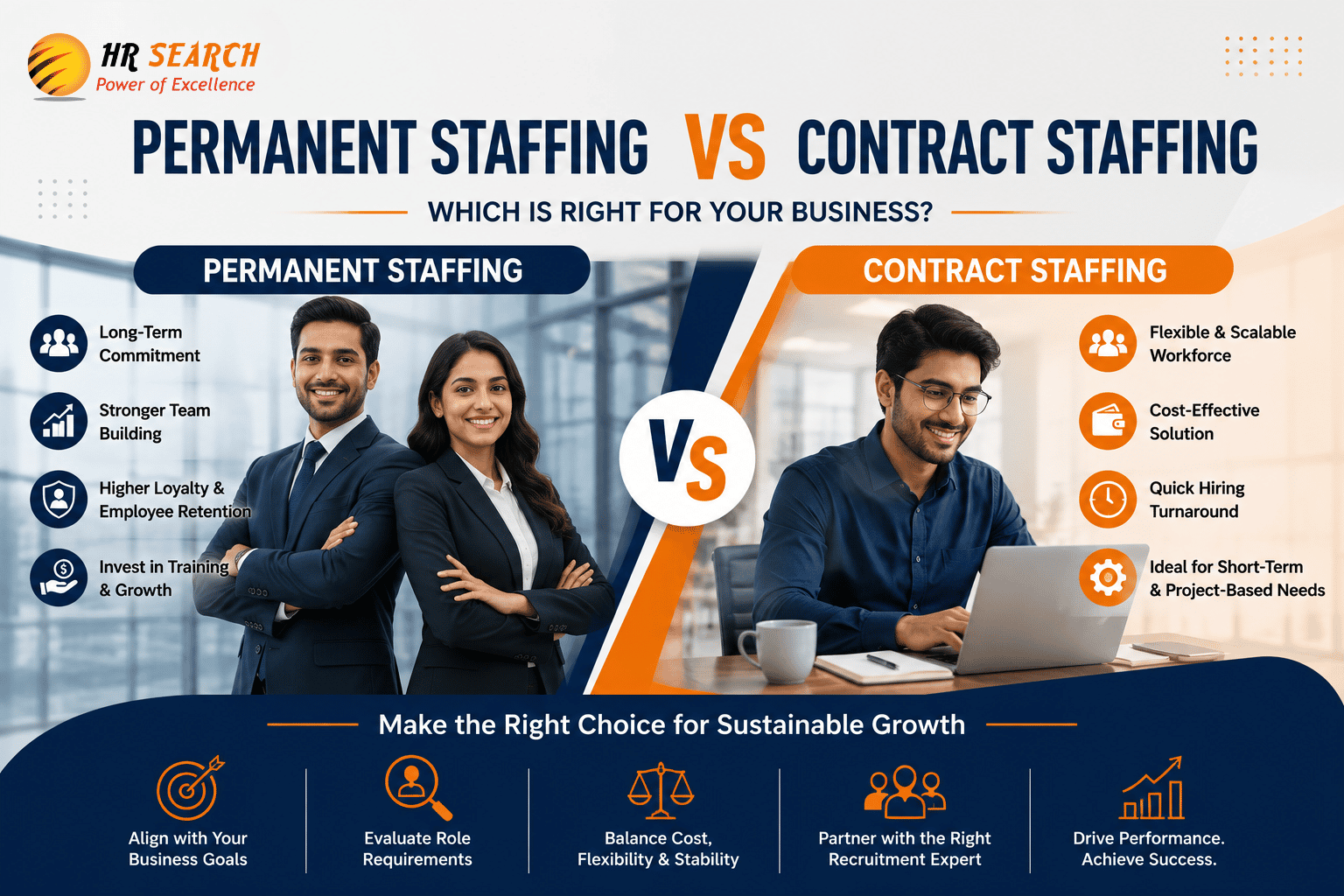
Introduction Permanent Staffing vs Contract Staffing
Every organization faces hiring decisions that directly impact productivity, growth, and operational efficiency. One of the most common questions businesses ask is whether they should hire permanent employees or engage contract professionals.
Both staffing models offer unique advantages depending on business objectives, project requirements, budget considerations, and workforce planning strategies.
Understanding the differences between permanent staffing and contract staffing can help organizations make informed hiring decisions and build a workforce that supports long-term success.
What Is Permanent Staffing?
Permanent staffing refers to hiring employees on a full-time basis who become a long-term part of the organization.
Permanent employees typically receive:
- Fixed salary
- Employee benefits
- Paid leave
- Career development opportunities
- Long-term employment stability
These employees contribute to company culture, business growth, and long-term organizational objectives.
Benefits of Permanent Staffing
Long-Term Workforce Stability
Permanent employees provide continuity and help build a stable workforce.
Strong Organizational Commitment
Long-term employees often develop stronger loyalty and engagement with company goals.
Better Cultural Alignment
Permanent staff become deeply integrated into company culture and operational processes.
Leadership Development
Organizations can nurture future leaders through training and career development programs.
Knowledge Retention
Business knowledge remains within the organization, reducing dependency on external resources.
Challenges of Permanent Staffing
While permanent staffing offers many advantages, businesses should also consider:
- Longer hiring timelines
- Higher employee benefits costs
- Increased onboarding investments
- Reduced workforce flexibility
Permanent hiring works best when organizations have predictable workforce requirements and long-term growth plans.
What Is Contract Staffing?
Contract staffing involves hiring professionals for a specific period, project, or assignment.
Contract employees may work:
- For a fixed duration
- On project-based assignments
- During seasonal demand periods
- For specialized business requirements
Contract staffing provides organizations with greater workforce flexibility.
Benefits of Contract Staffing
Faster Hiring
Contract positions can often be filled quickly to address urgent business needs.
Workforce Flexibility
Businesses can scale teams up or down based on workload and project requirements.
Access to Specialized Skills
Organizations can engage experts without long-term employment commitments.
Cost Management
Contract staffing can reduce costs associated with permanent employee benefits and long-term obligations.
Project-Specific Support
Ideal for short-term initiatives, technology implementations, and business expansions.
Challenges of Contract Staffing
Organizations should also consider potential limitations:
- Limited long-term commitment
- Higher turnover rates
- Reduced organizational integration
- Continuous workforce planning requirements
Contract staffing is most effective when flexibility and speed are business priorities.
Permanent Staffing vs Contract Staffing: Key Comparison
| Factor | Permanent Staffing | Contract Staffing |
|---|---|---|
| Employment Duration | Long-Term | Short-Term |
| Workforce Stability | High | Moderate |
| Flexibility | Limited | High |
| Hiring Speed | Moderate | Fast |
| Employee Benefits | Included | Limited |
| Training Investment | Higher | Lower |
| Project-Based Hiring | Less Suitable | Highly Suitable |
| Leadership Development | Strong | Limited |
When Should You Choose Permanent Staffing?
Permanent staffing is ideal when:
- Hiring for core business functions
- Building leadership teams
- Expanding long-term operations
- Creating organizational stability
- Developing future managers and leaders
Examples:
- HR Managers
- Finance Managers
- Operations Heads
- Department Leaders
- Business Development Managers
When Should You Choose Contract Staffing?
Contract staffing is ideal when:
- Managing temporary workload increases
- Launching new projects
- Filling short-term skill gaps
- Handling seasonal demand
- Supporting organizational transitions
Examples:
- Project Engineers
- IT Specialists
- Consultants
- Contract Recruiters
- Temporary Operations Staff
Can Businesses Use Both Staffing Models?
Absolutely.
Many successful organizations combine both approaches to create a balanced workforce strategy.
For example:
Permanent Team
- Leadership
- Core Operations
- Strategic Functions
Contract Team
- Project Support
- Technical Specialists
- Temporary Workforce
This hybrid approach allows businesses to maintain stability while remaining agile and cost-efficient.
Read More: Top Recruitment Trends in India for 2026
How HR Search (India) Pvt. Ltd. Supports Staffing Solutions
HR Search (India) Pvt. Ltd. helps organizations identify the right staffing model based on their workforce requirements and business goals.
Our services include:
- Permanent Staffing
- Contract Staffing
- Executive Search
- Talent Acquisition
- Bulk Hiring Solutions
- Industry-Specific Recruitment
We work closely with employers to develop recruitment strategies that support growth, productivity, and long-term success.
Conclusion
There is no one-size-fits-all staffing solution. The right choice depends on your organization’s objectives, workforce requirements, budget, and operational priorities.
Permanent staffing provides stability, commitment, and long-term growth potential, while contract staffing offers flexibility, speed, and specialized expertise.
Businesses that understand when and how to use each model are better positioned to build effective teams and remain competitive in today’s evolving job market.
Looking for Recruitment Support?
Whether you need permanent employees, contract professionals, or specialized recruitment solutions, HR Search (India) Pvt. Ltd. can help you find the right talent.
Contact our recruitment specialists today to discuss your hiring requirements.